

Open a food truck, walking restaurant
Verified 21 February 2026 - Entreprendre Service Public / (Prime Minister)
Embark on the street food, open a food truck represents an interesting solution in particular for starting an activity. We explain step by step the steps to be carried out.
Project Preparation
What is the nature of the activity?
The profession of restaurateur can be a commercial or artisanal activity.
Generally, food trucks are run by a cook who makes the dishes himself from fresh products, called « homemade ». He then carries out a craft activity.
In addition, the majority of food trucks employ no more than 11 employees. Below this threshold, the company must be registered in the National Register of companies (RNE) as a company in the trades and crafts sector.
On the other hand, if a food truck employs more than 11 employees, French trade and companies register registration (RCS) is mandatory.
The majority of food truck companies are artisanal. To learn more, you can consult our sheet which specifies the conditions to be met to have the status of craftsman.
What skills are useful to manage a company?
It is important to think upstream about skills that will be useful to manage a company.
The company creator may be confronted in particular with difficult situations.
If its activity expands, it will also be required to hire and supervise staff.
Tests and training exist to target skills useful for company creation.
There are, for example, following tests :
Entrepreneurial test "Character traits"
Entrepreneurial test "Determination and motivation"
Entrepreneurial test "Resources and skills"
These tests accompany the reflection of the project leader.
They are not definitive answers without alternatives. It is always possible toacquire new skills.
Please note
It is advisable, where possible, toanticipate difficulties. If the project leader has the possibility to constitute a financial reserve, it can allow him to face an unforeseen event. It is also prudent to anticipate a steady pace of work, at least when starting the activity: weekend and evening, overtime.
Accompaniment of the project leader
In order not to remain alone with your project, the following steps can be beneficial:
- Meet other contractors of the same sector of activity
- Getting to fairs and trade shows in connection with the future activity
- To be accompanied by the consular networks : advisers CMA: titleContent in the case of a craft activity, in particular via the Pass Freedom of CMAsupport for formalities ; advisers of CCI: titleContent of its department in the case of a commercial activity.
- To be accompanied by associative networks :
Financial aid
If the project leader does not have enough own funds to launch your company, there are external financial solutions.
It is possible to consult our page dedicated to the looking for funding to start or take over a company. The crowdfunding or crowdfunding is also an interesting option.
When the project leader starts his activity, he can opt for aid schemes such as:
- The contract to support the company project (Cape) which relieves the creator of certain administrative formalities and guarantees the professional
- THEaid for the creation or resumption of a company (Acre) which consists of a temporary exemption from social security contributions at the beginning of activity
- Or theArce (Aid for the resumption or creation of a company) which allows the jobseeker who wishes to set up or take over a company to receive part of his unemployment benefits as capital.
The following website lists all the state aid existing:
Entrepreneurship training
It is important to prepare for your future status as a restaurant entrepreneur.
The training courses the following help to better understand it:
- Perform a immersion course in the catering sector
- Consult the website of France Travail which lists all the accompanying persons to creation
- Get closer to the French chamber of trades and crafts (CMA) from his region. It proposes support for company creation.
- If the project leader is a job seeker, France Labor (formerly Job center) offers training courses to prepare for company creation
- Learn management and accounting.
These courses are optional, but highly recommended.
The choice of a legal form (or legal status) of the company is a decisive step.
It determines the company’s operating rules, but it also has implications for the tax system and social protection.
There are two main legal forms:
- Individual business (EI) : allows you to carry out your activity alone and in your own name. The Head of company and the individual business shall form a one and the same person. Micro-company (or self-company) is an individual business with a simplified tax and social system.
- Business : allows you to work in a legal entity distinct from the head of company. It has the legal personality, i.e. it has its own legal existence (share capital, company name, registered office, etc.).
These two modes of exercise each have their own specific rules:
Répondez aux questions successives et les réponses s’afficheront automatiquement
Individual business (including micro-entrepreneur)
The creation of an individual business (EI) involves few formalities (no drafting of statutes, no constitution of share capital and partner, etc.) and allows to launch its activity quickly. The assets of the individual entrepreneur (IC), including the micro-entrepreneur, are automatically separated into professional and personal assets.
For more information, please refer to the fact sheet on the separation of professional and personal assets.
The tax and social system of traditional individual business
The individual entrepreneur is subject to income tax (IR), in the category corresponding to his activity (BIC: titleContent, BNC: titleContent , BA: titleContent..).
However, it is possible for him to opt for actual tax regime or even for thebusiness tax (IS).
The individual contractor is subject to the Social security for the self-employed regime. He has the status of self-employed person (TNS). It does not pay social contributions during at least 90 days which follow the start of its activity.
For more information, our factsheet on the social protection for traders and craftsmen details of the contributions due and the arrangements for reporting and payment.
Our sheet on theindividual business (EI) specifies all operating rules.
Simplified micro-company regime
The scheme of micro-entrepreneur is a very simplified social and tax system. It is applicable when the turnover HT: titleContent did not exceed certain thresholds in each of the previous 2 years.
Warning
Since 1er in january 2026, these thresholds were reassessed: €203,100 in the case of an activity of selling goods (instead of €188,700 in 2025), and €83,600 for the provision of services (instead of €77,700 in 2025).
The simplified scheme shall apply automatically for the year of establishment (N) and the following year (N+1) provided that these thresholds are respected.
Furthermore, the micro-company is subjected to the TVA-based franchise : that is, the contractor does not declare the TVA on the services or sales he performs and cannot deduct it either.
Regarding the taxation of his income, the micro company is imposed on theIR: titleContent, in the category corresponding to its activity: micro BIC: titleContent, microphone BNC: titleContent , microphone BA: titleContent..). The tax due is calculated taking into account a flat-rate abatement turnover for professional expenses which varies according to the activity carried out (for an activity of selling goods: the allowance corresponds for example to 71% turnover).
For more details on tax rebates, you can consult the sheet on the micro-entrepreneur tax system.
Finally, the entrepreneur pays social security contributions only if he generates turnover.
Business
The business is a legal entity that has a legal personality, i.e. it has its own legal existence (share capital, company name, registered office, etc.). It can sign a commercial lease, hire employees and has a separate estate from that of its partners. It is represented by an officer (a manager or a president) who carries out the activity.
The interest of create a business is to limit the liability of the professional and his associates to the contributions made when the business was established. It thus makes it possible to protect the personal assets of each individual.
The trader may engage in a commercial and/or craft activity alone (creating a EURL or a SASU) or byassociating with other persons (SARL, SAS, SAetc). The creation of a business requires the completion of various formalities such as the drafting of statutes, the deposit of a share capital which can be expensive. In addition, the business must comply with various accounting obligations (keeping and filing of annual accounts, convening of shareholders at general meetings (AGMs), holding of AGMs for any change in the statutes of the business, etc.).
Tax system
The profits made by the business are in principle subject tobusiness tax (IS). For certain types of businesses, partners can opt for income tax (IR). In this case, the benefits carried out shall be reported as BIC: titleContent in the income tax return.
Social protection
The social protection of the business manager varies according to the type of business chosen. The head of an EURL or SARL (if in the majority) is considered a self-employed person and must contribute to the Urssaf on income from self-employment or on a minimum annual basis.
The head of an SAS, SASU, SARL (minority or egalitarian) is considered to be a salaried assimilated worker. It is part of the general social security system. He enjoys a social protection very close to that of an employee. If he does not pay himself wages, he does not have to pay social security contributions.
To make the right choice, it is therefore essential to take into account many factors:
- Exercise of the activity alone or with several partners (in business )
- Tax regime for the taxation of profits
- Social protection scheme according to the envisaged legal form.
To help you choose the legal form that best suits your situation, the Urssaf offers the following simulator:
Finding the right legal status (form) for your company project
Status of the Individual Contractor (IE)
Micro-company regime
Companies affected by the IS
Strategic choice: adapt its catering offer
The success of a food truck often depends on its location.
It may be useful to perform a customer analysis on the territory envisaged.
The commercial offer of the food truck must correspond to the needs and to behaviors the future target clientele.
It is therefore important to adapt the type of catering to your customers or to change your location.
There are many possibilities; there are for example rotisserie trucks, pizzeria trucks, pancake trucks, Asian food trucks, others offer only burgers, etc.
Example :
A food truck installed in front of a cinema in an urban area will not necessarily offer the same commercial catering offer as in front of a sports stadium in a rural environment.
Analysis of the territory
The area where the project is located must be subject to prior analysis (economic, social, cultural, etc.).
THEDirectory of companies can be used as an advanced search tool (free of charge) to list companies on a territory and in a field of activity.
Company Directory: Find all the information in a company
FYI
Only one market research complete allows you to define needs of a clientele considered. For more information, you can consult the page dedicated to How to carry out a market study?
The big options
Several types of install pitches for a food truck are possible:
- One fixed place on fixed days and hours
- Multiple locations : for example, a place for the noon and another on evening
- Of markets, halls
- In front of cultural or sporting events such as concert halls, cinemas, stadiums, etc.
It is possible to mix the different possibilities. However, it is important to retain a clientele by offering fixed appointments.
Please note
Each of these options requires a authorization (AOT) install for a food truck in thepublic space. The professional must also obtain a merchant/craftsman card (see details below under « Formalities » and « Operation »).
Truck or trailer?
It is possible either to use a truck or a vehicle with a trailer.
The truck has the advantage of being ready to use as soon as the driver stops the engine. The trailer, on the other hand, requires an installation at each place where he wishes to work.
The professional must indeed know unhitch the hitch and attach trailer on the ground in a balanced way. This makes the installation longer for a truck. The trailer is also more difficult to drive.
If the truck falls into failure, all the activity is blocked, whereas with a trailer the professional is less dependent on breakdowns.
The advantage of a trailer is not to lose value and to be able to resold easier than a truck.
It is also simpler to change offer catering with a trailer, if the professional wishes.
Please note
In the case of a trailer, it shall be registered if its PTAC is greater than 500 kg ; which is very often the case given the weight of the equipment.
Issuance of Certificate of Registration
How much does it cost?
A new truck will cost between €30,000 and €100,000 approximately according to the type of restoration and according to the facilities.
Example :
A rotisserie truck will cost more with its rotisserie than a burger truck with a plancha and a fryer, and even more than a creperie truck with its crepe makers. The pizza truck will also be more expensive because of its oven and its high safety standards.
A new trailer will cost between €10,000 and €20,000, depending on the equipment.
New or used?
The new purchase is of course more expensive, especially for a truck.
Even if most professionals are serious, it is more prudent to check the certificates of compliance with health and safety rules.
Warning
In the case of a used vehicle purchase, it will be necessary to check that the equipment of the truck is up to safety and hygiene standards. For this, the buyer must recover all the certificates. The controls are common and activity can be stopped for non-compliance.
Rent a truck?
Renting a truck can be a wise choice for test its activity. The consequences in case of failure will be less serious than if the professional goes into debt for the purchase of a truck.
This allows you to refine your idea and change it if necessary, for example depending on the type of restoration offered.
Verification of gas and electricity equipment and installations
New or used, the truck or trailer and their equipment must meet standards strict safety and hygiene.
The equipment must have a water point.
In case of cooking, there must be a hood evacuation.
The restaurateur must be in possession of certificates of conformity of all equipment. these must be properly fixed, watertight and washable.
Vehicle Insurance
Like all motor vehicles, the owner of the vehicle has thelegal obligation to insure the truck (against theft, accidents, etc.).
It is important to clarify to the insurer that it is a working tool. Truck insurance can be taken out at the same time as insurance for the activity (professional comprehensive insurance and professional liability).
Please note
This insurance for the activity is mandatory to make a application for a traveling business card, which is itself necessary to exercise. It is also required when applying for a temporary occupation permit (of the public space) AOT.
Obligation to insure the vehicle
Driving license
The total permissible laden weight (PTAC) of the vehicle determines the type of driving license that the professional must possess.
The PTAC is registered in the F2 entry of the vehicle registration certificate of the vehicle.
In the case of a trailer, it is necessary to look at both the PTAC of the trailer and the PTAC total, i.e. the addition of the PTAC of the towing vehicle + the PTAC of the trailer.
The type of driver's license is different depending on the weight of the truck or towed coupling with trailer.
Répondez aux questions successives et les réponses s’afficheront automatiquement
Truck less than 3.5 t PTAC
If the food truck has a PTAC: titleContent less than or equal to 3.5 tons permit B enough.
Truck over 3.5t from PTAC
If the food truck has a PTAC: titleContent greater than 3.5 tons, the driver must possess the truck license. This is one of the C permits, including the C1 permit.
Trailer and towing vehicle
Food truck trailers very often weigh more than 750 kg. The following information corresponds to this criterion.
Trailer + towing vehicle less than 4.25 t
If the hitch meets the following 2 criteria:
- PTAC: titleContent of the trailer exceeding 750 kg,
- and maximum permissible mass of the assembly, car + trailer, greater than 3 500 kg but less than 4 250 kg,
then the driver must possess the permit B and take an internship d'1 day driving school.
The driver's license will then be marked B96, without examination.
Trailer + towing vehicle over 4.25 t
If the hitch meets the following 2 criteria:
- PTAC: titleContent of the trailer exceeding 750 kg,
- and maximum permissible mass of the assembly, car + trailer, greater than 4 250 kg,
Categories of driving license
Training for category B96 of the driving license
Vehicle registration certificate mention VASP-Magasin
The food truck or trailer must receive theapproval VASP: titleContent : specially equipped motor vehicle, with the words « Shop ».
Without this, the driver will not be granted permission to drive when he passes the roadworthiness test.
This approval warrants that the truck or trailer complies with the safety standards corresponding to the professional activity.
The restorer must ask this VASP approval with the Drealfrom his region:
Registration under the genus VASP
Formalities of creation
The choice of a legal form (or legal status) of the company is a decisive step.
It determines the company’s operating rules, but it also has implications for the tax system and social protection.
There are two main legal forms:
- Individual business (EI) : allows you to carry out your activity alone and in your own name. The Head of company and the individual business shall form a one and the same person. Micro-company (or self-company) is an individual business with a simplified tax and social system.
- Business : allows you to work in a legal entity distinct from the head of company. It has the legal personality, i.e. it has its own legal existence (share capital, company name, registered office, etc.).
These two modes of exercise each have their own specific rules:
Répondez aux questions successives et les réponses s’afficheront automatiquement
Individual business (including micro-entrepreneur)
The creation of an individual business (EI) involves few formalities (no drafting of statutes, no constitution of share capital and partner, etc.) and allows to launch its activity quickly. The assets of the individual entrepreneur (IC), including the micro-entrepreneur, are automatically separated into professional and personal assets.
For more information, please refer to the fact sheet on the separation of professional and personal assets.
The tax and social system of traditional individual business
The individual entrepreneur is subject to income tax (IR), in the category corresponding to his activity (BIC: titleContent, BNC: titleContent , BA: titleContent..).
However, it is possible for him to opt for actual tax regime or even for thebusiness tax (IS).
The individual contractor is subject to the Social security for the self-employed regime. He has the status of self-employed person (TNS). It does not pay social contributions during at least 90 days which follow the start of its activity.
For more information, our factsheet on the social protection for traders and craftsmen details of the contributions due and the arrangements for reporting and payment.
Our sheet on theindividual business (EI) specifies all operating rules.
Simplified micro-company regime
The scheme of micro-entrepreneur is a very simplified social and tax system. It is applicable when the turnover HT: titleContent did not exceed certain thresholds in each of the previous 2 years.
Warning
Since 1er in january 2026, these thresholds were reassessed: €203,100 in the case of an activity of selling goods (instead of €188,700 in 2025), and €83,600 for the provision of services (instead of €77,700 in 2025).
The simplified scheme shall apply automatically for the year of establishment (N) and the following year (N+1) provided that these thresholds are respected.
Furthermore, the micro-company is subjected to the TVA-based franchise : that is, the contractor does not declare the TVA on the services or sales he performs and cannot deduct it either.
Regarding the taxation of his income, the micro company is imposed on theIR: titleContent, in the category corresponding to its activity: micro BIC: titleContent, microphone BNC: titleContent , microphone BA: titleContent..). The tax due is calculated taking into account a flat-rate abatement turnover for professional expenses which varies according to the activity carried out (for an activity of selling goods: the allowance corresponds for example to 71% turnover).
For more details on tax rebates, you can consult the sheet on the micro-entrepreneur tax system.
Finally, the entrepreneur pays social security contributions only if he generates turnover.
Business
The business is a legal entity that has a legal personality, i.e. it has its own legal existence (share capital, company name, registered office, etc.). It can sign a commercial lease, hire employees and has a separate estate from that of its partners. It is represented by an officer (a manager or a president) who carries out the activity.
The interest of create a business is to limit the liability of the professional and his associates to the contributions made when the business was established. It thus makes it possible to protect the personal assets of each individual.
The trader may engage in a commercial and/or craft activity alone (creating a EURL or a SASU) or byassociating with other persons (SARL, SAS, SAetc). The creation of a business requires the completion of various formalities such as the drafting of statutes, the deposit of a share capital which can be expensive. In addition, the business must comply with various accounting obligations (keeping and filing of annual accounts, convening of shareholders at general meetings (AGMs), holding of AGMs for any change in the statutes of the business, etc.).
Tax system
The profits made by the business are in principle subject tobusiness tax (IS). For certain types of businesses, partners can opt for income tax (IR). In this case, the benefits carried out shall be reported as BIC: titleContent in the income tax return.
Social protection
The social protection of the business manager varies according to the type of business chosen. The head of an EURL or SARL (if in the majority) is considered a self-employed person and must contribute to the Urssaf on income from self-employment or on a minimum annual basis.
The head of an SAS, SASU, SARL (minority or egalitarian) is considered to be a salaried assimilated worker. It is part of the general social security system. He enjoys a social protection very close to that of an employee. If he does not pay himself wages, he does not have to pay social security contributions.
To make the right choice, it is therefore essential to take into account many factors:
- Exercise of the activity alone or with several partners (in business )
- Tax regime for the taxation of profits
- Social protection scheme according to the envisaged legal form.
To help you choose the legal form that best suits your situation, the Urssaf offers the following simulator:
Finding the right legal status (form) for your company project
Status of the Individual Contractor (IE)
Micro-company regime
Companies affected by the IS
Before making the registration the professional must have chosen a trade name or a denomination for his company. The choice is different for an individual business or a business.
Répondez aux questions successives et les réponses s’afficheront automatiquement
Individual entrepreneur (including micro-company)
If the restaurateur chooses to practice as an individual contractor (IC) the name of his company will be the same as his proper name (or last name).
Indeed, in the case of an EI (legal form that also includes micro-company), the professional is responsible as a natural person of his company, he exercises in his proper name. The name of its company corresponds to its proper name.
The trader can also choose a trade name in parallel. Unlike the name, it is optional. It can be used to better identify the activity of the company, particularly in its communication activities.
For more details, it is possible to consult our page on individual business name (EI).
Please note
On all company documents, the word « EI » must appear after the name.
Name of individual contractor (IC)
Business
If the restaurateur has chosen to practice under the legal form of the business, the corporate name of his company is free.
The name often reflects the activity carried out. He must write the chosen name in the statutes of the company.
For more details, it is possible to consult our page dedicated to name of a business.
Declaration and registration of a business
Limited liability company (SARL): company name (L223-1)
Declare the activity on the company formalities window
Legal existence of the company and identification numbers
The trader must register the company.
This procedure must be carried out online on the website of the companies' formalities office:
The trader must apply for registration within one month before the declared start date of the activity and, at the latest, 15 days after the start date of the activity. This formality has the effect of giving the company legal status.
This declaration informs all the organizations concerned by the launch of the activity (Insee, social organizations, Urssaf, public finance center, etc.).
As soon as the application for registration is accepted, the Insee shall award:
- A number Siren : it is a unique identification number of the 9-digit company
- A number Siret : this is thegeographical identifier of each of the establishments from the company, it is therefore possible to have several. This number consists of the Siren and a NIC (Internal Ranking Number).
When registering the company, the Insee also assigns the professional its code APE: titleContent.
Domiciliation of the company
When registering on the website of the company formalities desk, the company's address must be entered.
It usually corresponds to the premises (shop, workshop, etc.) in which the activity is carried out.
If the trader owns both a fixed establishment and another itinerant, he may domiciliate the itinerant activity at the same address as the fixed premises, such as 2d establishment.
When the activity is only itinerant, the trader may choose to domiciliate his activity at his personal address or by means of a domiciliation business.
For more information, please refer to our page Home your individual business (including micro-company), or Domiciliate your business.
Please note
In case of itinerant activity, you must ask for a tradesman or street vendor card from the CCI: titleContent or CMA: titleContent the location of the activity.
Declaration of the prospective spouse working in the company
When the spouse (married, partner of Civil partnerships: titleContent or common-law partner) of the head of company professional activity regular in the company, a sworn certificate must be provided, stating his status. It is possible to opt for one of the following statuses: collaborating spouse, salaried spouse, associate spouse.
The choice of status guarantees the spouse rights, including pension rights.
When registering the company, the Head of company declares the status chosen by the spouse on the website of the company formalities desk by providing the following document:
For more information on the status of the spouse, please refer to the fact sheet on the spouse of the head of company.
FYI
If no status has been declared, the spouse is considered to have opted for the status of salaried spouse.
Submit a declaration of non-conviction
When registering his activity on the company Formalities Window, the trader must provide a declaration on honor of non-conviction.
By this declaration, he certifies that he has not been subject to any criminal, civil or administrative sanction prohibiting him from setting up and managing a company.
One template declaration of non-conviction and filiation is available:
Spouse, employee, partner: status, rights, formalities
Declarations at the time of registration
Deadline for trader/business registration
The professional must declare the existence of his restaurant and his activity to the town hall of the commune where thecompany is domiciled.
This declaration must be made 15 days minimum before opening from the restaurant.
FYI
For more details, it is possible to consult the page dedicated to domiciliation of an individual business or to the domiciliation of a business.
This statement is made in filling out the form next:
Declaration of a restaurant or beverage outlet to be consumed on site or to take away
What is the traveling merchant card?
The professional restaurateur who operates a food truck must have the traveling business card.
This card allows him to move outside of the municipality of its professional domicile.
Every trader is concerned by this obligation whether or not he has a fixed commercial premises and whatever his status.
If the company hires one or more employees, they must have a copy of the executive's traveling business card when they are practicing on a traveling basis.
The card is valid 4 years.
It costs €30.
How do I get the traveling business card?
To obtain the card, the professional must make a prior declaration for theexercise of a walking activity.
It must come close to either the chamber of commerce and industry (CCI) or the chamber of trades and crafts (CMA) of its place of attachment.
This is the chamber (CCI or CMA) responsible for the municipality of the registrant's domicile, business address or the registered office of the business.
The CCI processes applications from professionals registered with the RCS: titleContent. The CMA handles requests from professionals who are registered exclusively in the RNE: titleContent, be registered with the RCS and the RNE.
Many CMA and CCI use the cerfa form no. 14022 next:
Prior declaration for the exercise of a traveling commercial or craft activity
Some CMA and CCI offer a form specific to their region.
FYI
Some CCI offer a completely different approach dematerialized to apply for a traveling merchant card. This is the case, for example, of the CCI Bretagne. It is then indicated upstream of the formality, the technical conditions necessary for the smooth running of the process (electronic signature, digitized photographic retouching, format of the identity document, etc.). One detailed instructions for use are available online.
The form must be completed, scanned and forwarded to the CCI or CMA (either by registered post with acknowledgement of receipt, or on site, or by email depending on the region).
The cost of the card is €30.
The documents to be provided are listed below and are often also mentioned on the page dedicated to this approach on the CMA or CCI website.
When applying for a merchant or craftsman card, the professional must provide supporting documents, in addition to form 14022.
The documents are different depending on the country of establishment, in France or in a country of the (UE):
France
- Proof of declaration of activity less than 3 months old:
- If the registrant is registered in the Trade and businesses Register (RCS): a K or Kbis extract less than 3 months old
- If the registrant is registered in the National Register of companies (RNE): a proof of registration less than 3 months old with the entries in this register
- Copy of the identity document valid: copy of passport or national identity card, or double-sided copy of residence permit
- For the persons hosted : in the case of accommodation with an individual, an original accommodation certificate signed by the host and a copy of the proof of domicile of the host - in the case of accommodation in a social center, a copy of the certificate of domicile of the social organization such as the Center d'Action Sociale (CCAS) or the Center Intercommunal d'Action Sociale (CIAS), to which the municipality of attachment depends
- 2 recent identity photographs in 35 x 45 mm format
- Check of €30 directed to the CCI or CMA.
Condition of the {circumflex over (UE)}
- Proof of declaration of activity: for natural and legal persons who do not have an establishment in France but who have declared their commercial or craft activity in another EU country, the document must be translated into French and mention the activity (this must allow a non-sedentary commercial activity)
- Copy of the identity document valid: copy of passport or national identity card, or double-sided copy of residence permit
- Copy of a proof of address recent on behalf of the legal representative of the company (e.g. last rent receipt or last gas or electricity bill, voter registration, tax receipts, tax warning, telephone bill)
- For the persons hosted : in the case of accommodation with an individual, an original accommodation certificate signed by the host and a copy of the proof of domicile of the host - in the case of accommodation in a social center, a copy of the certificate of domicile of the social organization such as the Center d'Action Sociale (CCAS) or the Center Intercommunal d'Action Sociale (CIAS), to which the municipality of attachment depends
- 1 recent photograph in 35 x 45 mm format
- Check of €30 directed to the CCI or CMA.
If the file is complete, the professional receives a card in the 15 days approximately after the form and supporting documents have been sent, and within a maximum of one month.
He can ask for a provisional certificate valid for one month if it is to start its activity.
The card is valid 4 years, after which it must be renewed at the professional's initiative.
In case of control, thelack of declaration prior to obtaining the card, generates a fine from €750. If the professional has forgotten to take his card with him during his business trips or if he has forgotten to carry out his renewal, the fine is €450.
Who shall I contact
Obligation of a traveling merchant card
Declaration procedure, card receipt, control and sanctions
Supporting documents to be provided to apply for the card
Domiciliation of registered persons
Obligation of a traveling merchant card
Declaration procedure, card receipt, control and sanctions
Supporting documents to be provided to apply for the card
How to renew the mobile business card?
The map is valid for 4 years.
If the professional wishes to renew his card, he must make the request.
This request can be made from1 month before the expiry date of validity and up to 2 months after this date. If this time limit is exceeded, an initial request must be repeated.
The renewal request is made by filling in the Cerfa form n° 14022, which can be downloaded from the professional's CCI or CMA website.
This is the chamber (CCI or CMA) responsible for the municipality of the registrant's domicile, business address or the registered office of the business.
The CCI processes applications from professionals registered with the RCS: titleContent. The CMA handles requests from professionals who are registered exclusively in the RNE: titleContent, be registered with the RCS and the RNE.
This form must be completed and sent either by registered post with acknowledgement of receipt or by email in certain regions.
Prior declaration for the exercise of a traveling commercial or craft activity
Please note
Some CCI offer a completely different approach dematerialized to apply for a traveling merchant card. This is the case, for example, of the CCI Bretagne. It is then indicated upstream of the formality, the technical conditions necessary for the smooth running of the process (electronic signature, digitized photographic retouching, format of the identity document, etc.).
The time to receive the new card is between 15 days and one month.
It is possible to request a provisional certificate during the waiting period. It is valid for 1 month maximum. For this, the professional must return theold map.
Warning
To make location requests, the professional must have the following 2 elements:
- Unique identification number (Siren), which means that you have already registered your company
- Professional insurance for its activity.
Location on a sidewalk or public square
The restaurateur must request a parking permit.
This permit is intended for trade whose occupation of public space is right-of-way fixed to the ground.
How do I apply for a parking permit?
The file varies according to the municipalities.
It consists of a declaration form and documents to be provided. These are:
- or a form specific to the municipality. It can be either downloaded from the website of the town hall where the activity takes place (or the prefecture if the request concerns a major artery of the city), or available on site in the town hall or prefecture (if it is a major artery of the city, a departmental or national road).
- or form cerfa no 14023.
The documents to be attached to the form are as follows:
- Copy of the extract K or Kbis or proof of registration at RNE: titleContent
- For cafés, bars and restaurants: copy of the license on behalf of the owner or operator of the business
- Copy of commercial lease or title deed
- Certificate of insurance for the occupation of public space
- Description of the terrace or display and the materials used, with a plan specifying the location of the device on the sidewalk and its area
- Map of traveling trade
- Map of MSA: titleContent for agricultural producers
- Bank details (RIB).
Please note
The list of documents to be provided may vary from one municipality to another.
The file must be sent either to the town hall or to the prefecture if it is a major urban artery, a departmental or national road.
To know everything about parking permit applications, it is possible to consult our page dedicated to the occupation of the public domain by a business (AOT).
Authorization to occupy the public domain
Parking Permit and Temporary Deposit
General rules of occupation of the public domain
Location in a market
If the food truck wishes to enter one or more markets in its territory, it may choose either to request a fixed location or a flying seat.
Répondez aux questions successives et les réponses s’afficheront automatiquement
Fixed place
If the professional wishes to obtain a fixed location on a market covered or overdrawn, he must apply to the town hall concerned.
If he gets it, he will have to pay a place fee through a subscription (annual, quarterly or monthly).
For the sake of equality before public services, it is forbidden to reserve places for traders resident in the municipality.
Occasional flying place
If the professional wants a vacant pitch by the day (said steering wheel seat or passenger seat), he must make the request to the receiver-placier.
He pay then a fee per busy day.
According to the conditions detailed in the communal regulation, the allocation of vacant space can be carried out by drawing lots or by order of arrival, after registration on a waiting list.
For the sake of equality before public services, it is forbidden to reserve places for traders resident in the municipality.
FYI
For more details, you can consult the following page: How to request a location in a market or market hall?.
Halls and markets
Location in a festival, a fair, an event
The location request must be made to the event organizer.
It is also possible to inquire at the town hall concerned.
If he gets the location, the professional must pay a fee to the organizer.
The professional is not legally obliged to take out insurance for its activity of restorer.
Warning
However, holding insurance is necessary to obtain a traveling merchant card (mandatory for a food truck executive), as well as for any request forAOT: titleContent.
This is a professional property and casualty insurance. It may include professional civil liability (SPC).
The professional must ask his usual insurer.
She protects the restaurant owner, his property, his customers and possibly his employees (in the case of a CPR).
Protection concerns accidents:
- Hardware (merchandise stocks, IT, etc.),
- Intangible (operating loss),
- Bodily injury (accident, death).
For more details, it is possible to consult our pages dedicated to professional insurance, depending on the company (individual, microphone or business) .
Rules of operation
Who is concerned?
Training in food hygiene rules is mandatory in commercial catering establishments, including food trucks and vans.
Most of diplomas in the cooking and catering sector automatically includes this training.
All it takes isonly one of the persons the institution or company has completed the training. This training is optional for a professional who can justify at least 3 years of activity in the food sector as manager or operator.
Warning
This training should not be confused with training HACCP: titleContent which, in turn, falls under the European regulation known as the « Hygiene Package ».
How does the training take place?
The training lasts 2 p.m. minimum.
Its cost varies between €200 and €500 (based on market prices).
There is no deadline for the validity of this training or an obligation to renew it.
Where can I find a training organization?
It is issued by a body approved by the Ministry of Agriculture.
The list of training organizations registered in a region may be consulted on the website of the Regional Directorate for Food, Agriculture and Forestry:
The list of organizations providing this training in the regions is also available on the site of professionals in agricultural education: chlorofil.fr.
Food handlers must be supervised and have food hygiene instructions and/or training appropriate to their professional activity.
This training is often called HACCP training. It is aimed at the entire agri-food sector.
This obligation is established by the European regulation regulating food hygiene called « Hygiene Package ».
The name HACCP means in English Hazard Analysis Critical Control Point. It is a method of preventing and identifying hazards associated with food hygiene practices.
Any person manipulator of foodstuffs must have completed this training.
HACCP training can be provided either by a training organization or by the institution itself.
It is not subject to any content or duration requirements.
FYI
A company can organize its own training in good hygiene practices for its employees (through the dissemination of instructions, exchanges of practices...).) The use of an external service provider is not mandatory.
France Travail (formerly Job center) can help to find a provider performing this training:
Where to find my HACCP food hygiene training
Establishment of procedures based on HACCP principles
For any manipulating activity of food of animal origin for use in final consumers, the professional must make a declaration .
It has to be done before opening of the establishment. It must be addressed to the departmental directorate in charge of population protection (DDPP).
This declaration allows the Health and Food Safety Department of the DDPP to schedule health control visits.
Declaration of handling of food of animal origin
For more details, it is possible to consult our page on hygiene rules in catering and food shops.
Obligation of declaration, approval and health control
The sale of spirits of more than 18 degrees is forbidden, irrespective of the time and place of opening of the food truck. These are strong alcohols: rum, vodka, whisky, etc.
On the other hand it is possible to sell drinks whose alcohol title is lower à 18 degrees. These are mainly wine, beer and cider.
The obligations are not the same according to thetime to which those beverages are sold.
Alcohol sale before 10 p.m.
If the food truck sells alcohol titrating below 18 degrees before 10 p.m., a prior declaration enough.
The declaration must be sent at least 15 days before opening of the establishment.
The declaration must be forwarded to the town hall the company's place of residence, or prefecture if it is located in Paris or in Alsace-Moselle.
Declaration of a restaurant or beverage outlet to be consumed on site or to take away
Declaration for the sale of alcohol until 10pm: L3332-4-1
Sale of alcohol between 10pm and 8am
To sell alcoholic beverages titled to less than 18 degrees between 10pm and 8am, the professional must obtain a license called small take-away license.
For this, he must take training in a center of accredited training.
The training lasts approximately 8 p.m. (2.5 days).
If the professional completes the training, he or she will receive a operating license, or license to sell alcoholic beverages at night: PVBAN: titleContent.
This permit is valid 10 years.
It is renewable by performing a new 6-hour training.
Please note
For more than details on the sale of alcohol, you can consult the page entitled Licenses of a restaurant and drinks debit.
Training for sale alcohol to take away after 10pm
The display rules are numerous.
The main ones concern beverages, alcohol, protection of minors, prices of products and their origin.
Beverage Display
If it is concerned, the merchant must display its small license of exploitation (sale of alcohol to take away at night).
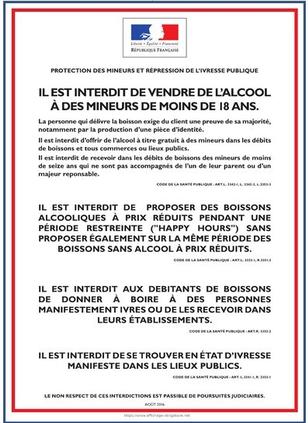
Ouvrir l’image dans une nouvelle fenêtre
It is a wall poster of A4 size (21 x 29.7 cm), on a white background. In the center at the top is inscribed the Marianne logo, blue, white, red.
Below are several excerpts of articles of law, from the Public Health Code, concerning the repression of public intoxication and the protection of minors with respect to the sale of alcohol.
Notably: "It is forbidden to sell alcohol to minors under 18 years of age."
Then it says: "It is forbidden to be intoxicated in public places".
"It shall be prohibited for the operator of a drinking establishment to give or receive drinking to persons who are manifestly intoxicated".
The display of the regulations on the suppression of public intoxication and the protection of minors (prohibition of sale of alcohol to persons under 18) is mandatory.
It is forbidden to sell or offer free alcohol to a minor (person under 18).
If the trader does so, he risks a fine of €7,500 and a ban on operating its license for 1 year.
FYI
It is mandatory to present a display of soft drinks for sale. At least 10 different drinks without alcohol must be visible by customers.
For more details, it is possible to consult our page on display obligations in a restaurant .
Meat Display
For meat, the trader must indicate the country d'origin from all meats (poultry, beef, pork, sheep) on the menu or on display, for any type of meat dish or meat preparation.
This indication of origin shall be one of the following:
- Either Origin: (country name) where the birth, rearing and slaughter took place in the same country.
- Either Born and raised : (name of country(ies)) and Slaughtered (name of country) where birth, rearing and slaughter took place in different countries.
This obligation does not apply to purchased meat already cooked for resale.
In case of non-compliance with these displays, the professional risks a fine of €1,500 for a natural person or €7,500 for a legal person.
Please note
For more details, it is possible to consult our page on display obligations in a restaurant .
Composition of the display of soft drinks
Protection of minors (display)
Repression of public intoxication
Indication of origin of meat products already cooked in restaurants
Indication of origin of meat in restaurants
To have the right to wear the mention Homemade, the dishes must be made from raw products (raw food), fresh, without assembly except with salt.
Dishes must be prepared on site.
An exception is made for street food, which can be mentioned even if the dishes were prepared in another establishment before being sold in the food truck.
For more details on the mention " Homemade », it is possible to consult our page: Terms of use of the « Homemade » logo in catering.
Condition to be a cook (« homemade »)
List of products and professionals concerned by the mention "homemade"
Contributions called by theUrssaf: titleContent depend on the structure of the business and the legal status of the manager.
To know all the rules concerning the social system of the manager, it is possible to consult the sheet relating to the Social protection of the business manager.
The professional who carries out his activity in his own name (individual business) or as majority manager of a business (such as an EURL or SARL), is affiliated to the Social security for the self-employed (SSI), the compulsory scheme for self-employed persons.
The professional must pay social contributions to the Urssaf from the beginning of his activity.
However, in practice, no contributions or social contributions are required during the first 90 days which follow the launch of its activity.
Since the income is not yet known at the start of the activity, the contributions are first calculated on a flat-rate basis for the first 2 years (at the same rates as those applicable during the course of business). They are then adjusted and regularized according to the real revenues of the fiscal year.
Contributions must be paid online in one of the following ways:
- Either every month : payment is made on the 5th or 20th of each month, by direct debit.
- Either every quarter : payment is made by direct debit, telepayment or credit card on 5 February, 5 May, 5 August and 5 November.
When he carries out his activity within the framework of a business and holds management functions that give him the status of employee equivalent (president or paid CEO of SAS for example), the professional reports to the general social security system.
His social security contributions are identical to those of an executive employee, and he enjoys equivalent social protection, with the exception of unemployment insurance (optional unemployment insurance is however possible).
Professionals covered by the social security scheme for self-employed persons
Basis for calculating contributions at the start of activity (paragraph 2)
90 days for first due date
Payment schedule for social security contributions (III)
Monthly payments
Quarterly payments
Employee equivalent managers covered by the general scheme (11° and 12°)
The food truck company, like many companies (with a few exceptions), must pay a property tax, called the CFE (company property tax). To know the cases of exemptions, it is possible to consult page dedicated to the CFE.
In addition, if the food truck has one or more advertising signs in the public space, the operator must inquire about the possible payment of the local tax on outdoor advertising (TLPE). This tax depends on each municipality. The operator must contact the town hall the location of its advertising sign.
Who can help me?
Find who can answer your questions in your region
- French Chamber of commerce and industry (CCI)
- French chamber of trades and crafts (CMA)
- Town hall
- French regional directorate of the environment, planning and housing (Dreal)
Associative networks
Network Undertake- BGE: support for entrepreneurs
- Initiative France Network
- France Active
- Adie: association for the right to economic initiative
Obligation of a traveling merchant card and prior declaration of activity
Obligations of tradesmen and craftsmen whose terms of application for the traveling business card: R123-208-2; renewal: R123-208-4
Training for sale alcohol to take away after 10pm
Categories of driving license
Compulsory food hygiene training
Trailer and PTAC towing vehicle less than 4.25 t
Online service
Search tools
Search tools
Online service
Online service
FAQ
Service Public
Service Public
Chambers of Crafts and Crafts (CMA)
Chambers of Crafts and Crafts (CMA)
France Labor
Chambers of Crafts and Crafts (CMA)
Ministry for the Environment
