


What are the rules for building or settling a fence?
Verified 05 December 2025 - Entreprendre Public Service / Directorate of Legal and Administrative Information (Prime Minister)
To build or settle a fence around your property, in principle you have no no formality to be accomplished. However, you must respect implementation rules, of height, and sometimes of city planning. Indeed, in some cases, you must file a preliminary declaration (DP) in the town hall. These rules vary according to the type of your fence (wall, green fence, fence...). We present the regulations to you.
Any owner has the right to fence his land, regardless of whether it is located in urban or rural areas. Before settling your fence, it is recommended to limit your land to know the limits of your property.
In any case, you must respect the MORE: titleContent of your municipality which may lay down rules concerning the height, nature, appearance or location of your fence in relation to neighboring properties and the public domain. These rules may also be provided for in local uses. To know them, you must contact the city planning department of your town hall, or the Basu: titleContent for Paris:
Warning
You must also comply with the rules contained in the specifications remitted upon acquisition if your land is located in a subdivision and those in the condominium rules if your land is in a condominium.
You must respect certain rules which vary according to type from your fence:
Wall
A fence wall can be made of stone, brick or concrete. When building it, you must respect rules of distance, layout and height. Your wall may also be subject to RFP.
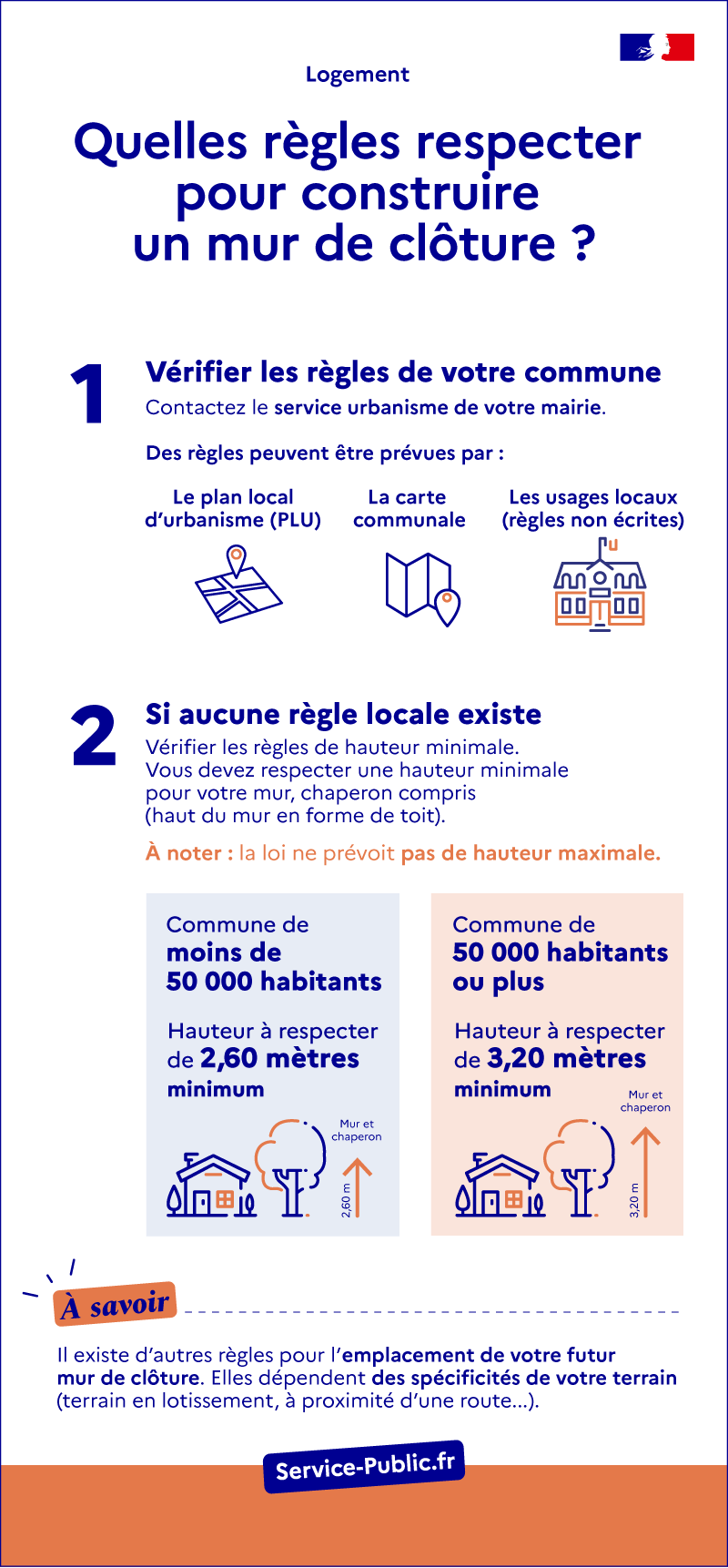
Infographie - What rules should be followed to build a fence wall?
Ouvrir l’image dans une nouvelle fenêtre
What rules should be followed to build a fence wall?
1. Check the rules of your municipality
Contact the city planning department of your town hall.
Rules may be laid down by:
- The local urban plan (PLU)
- The communal map
- Local customs (unwritten rules)
2. If no local rule exists
Check minimum height rules.
You must respect a minimum height for your wall, including chaperone (top of the roof-shaped wall).
Note: the law does not provide for a maximum height.
- Municipality of less than 50,000 inhabitants: Minimum height of 2.60 meters
- Municipality of 50,000 inhabitants or more: Minimum height of 3.20 meters
Did you know that?
There are other rules for the location of your future fence wall. They depend on the specificities of your land (land in subdivision, near a road...).
You must comply with distance and location rules in relation to:
- Neighboring land
- Servitudes
- Public domain and roads.
Distance and location rules in relation to neighboring land
You can build your fence wall on your land set back from the property boundary, without encroaching on your neighbor's land. It is then private.
You can also build it on the dividing line with the agreement of your neighbor. It is then adjoining. In this case, the sharing of construction and maintenance costs is to be decided in agreement with your neighbor.
Distance and location rules in relation to easements
You must respect existing easements on the land. Thus, you do not have to build a wall on a easement of passage and prevent its beneficiary from accessing the public highway.
Please note
You should also not obstruct the natural flow of rainwater.
Distance and location rules in relation to the public domain and traffic lanes
Implementation rules vary depending on the type of public domain (e.g. maritime public domain) or traffic lanes that border your land.
Répondez aux questions successives et les réponses s’afficheront automatiquement
Land on the edge of the maritime public domain
If you are a riparian owner of the public maritime domain, you can fence your land at a minimum distance of 3 meters to ensure the passage of pedestrians (bondage of passage).
Land on the edge of a watercourse
For close your land, you must respect a dminimum distance of 6 meters between your fence and the edge of the watercourse.
Warning
Facilities, structures, works and activities (IOTAs) near watercourses may be subject to declaration or authorization under the Water Act. To check it, you need to contact the water police office of the DDTM: titleContent.
Who shall I contact
Land on the edge of a towpath or operation of a federal watercourse
If you are a waterfront owner of a federal watercourse where there is a towpath or operating road, you must respect a minimum distance of 9.75 meters between your fence and the watercourse edge (bondage towing).
Warning
Facilities, structures, works and activities (IOTAs) near watercourses may be subject to declaration or authorization under the Water Act. To check it, you need to contact the water police office of the DDTM: titleContent.
Who shall I contact
Land at the edge of a dangerous lane
If your land is on the edge of a dangerous road in its accesses (crossings, turns, dangerous or inconvenient points), it is necessary to get closer to the road manager before building your wall.
The manager is different depending on the type of route:
Municipal road
If your land is on the edge of a municipal road, you must contact your town hall.
Intermunicipal road
If your land is on the edge of an intercommunal road, you must contact your town hall or the intercommunality.
Departmental road
If your land is on the edge of a departmental road, you must contact the services of the department.
National Highway
The situation differs if you live in Île-de-France or in another region:
General case
If your land is on a national highway, you must contact the Dir: titleContent.
In the Île de France
If your land is on a national highway, you must contact the Drieat Île-de-France: titleContent.
Land at the edge of a public road
If your land is on the edge of a public road, you must consider thealignment which determines the boundary between the public domain and riparian properties. You must inquire with the town hall, or the Basu: titleContent for Paris, to know these rules.
Land on the edge of a rural road
If your land is on the edge of a rural road, you must apply for a bounding certificate from the town hall.
You must not create a abnormal neighborhood disorder by erecting a fence that deprives your neighbors of sight or sunshine.
In the absence of local rules, the law does not provide for a maximum height, but minimum height which varies according to the situation of your land:
Répondez aux questions successives et les réponses s’afficheront automatiquement
Your land is located in a town of less than 50,000 inhabitants
Your wall, including the chaperone (top of the roof-shaped wall) when it exists, must respect a minimum height of 2.60 meters.
Your land is located in a municipality of at least 50,000 inhabitants
Your wall, including the chaperone (top of the roof-shaped wall) when it exists, must respect a minimum height of 3.20 meters.
Warning
If your land adjoining a dwelling is located in a natural or forest area, you cannot build a wall resting on foundations. This prohibition allows the free movement of wild animals.
In principle, you are exempt from city planning formality to build a fence wall. You are also exempt from city planning formality to build a retaining wall, except in protected area where an RFP is required.
However, you must deposit at the town hall, or at the Basu: titleContent for Paris, a RFP to build a fence wall in the following cases :
- Land located in a protected area
- Land located in an area delimited by the MORE: titleContent (e.g. natural or forest area or natural area of free movement of wild animals)
- Land located in a commune or part of a commune where the fence walls are subject to declaration.
To find out if your land is located in one of these areas, you must contact the city planning department of your town hall or the Basu: titleContent for Paris.
You must also file a RFP if your fence wall measures 2 meters or more :
Répondez aux questions successives et les réponses s’afficheront automatiquement
General case
You must complete and submit your RFP file by dematerialized means according to the arrangements made by your municipality or on a paper form.
Ask on the website of the town hall or on site.
On the internet
You can complete and submit your RFP application on the Internet:
Form
You can complete your RFP application using a form:
Prior declaration of constructions and works not subject to building permits
In Paris
You must submit your file to the Reception and User Service Office (Basu: titleContent) only by dematerialization:
Office reception and service to the user (Basu) of Paris: one-stop shop
Vegetable fence
A fence can be hedges, trees or shrubs. When planting it, you must respect rules of distance, implantation and height.
You must comply with distance and location rules in relation to:
- Neighboring land
- Servitudes
- Public domain and roads.
Distance and location rules in relation to neighboring land
You can plant your fence on your land away from the property boundary, without encroaching on your neighbor's land. She is then private.
You can also plant it on the dividing line with the consent of your neighbor. She is then semi-detached. In this case, the sharing of planting and maintenance costs is to be decided in agreement with your neighbor.
The placement of a green fence set back from the property boundary depends on the height of your plantations :
- Planting less than or equal to 2 meters: the minimum distance to be respected from the separating limit is 0,5 meters
- Planting greater than 2 meters: the minimum distance is 2 meters from the separating limit.
These distances are measured from the middle of the trunk.
Distance and location rules in relation to easements
You must respect existing easements on the land. Thus, you can not plant a plant fence on a easement of passage and prevent its beneficiary from accessing the public highway.
Please note
You should also not obstruct the natural flow of rainwater.
Distance and location rules in relation to the public domain and traffic lanes
Implementation rules vary depending on the type of public domain (e.g. maritime public domain) or traffic lanes that border your land.
Répondez aux questions successives et les réponses s’afficheront automatiquement
Land on the edge of the maritime public domain
If you are a riparian owner of the public maritime domain, you can fence your land at a minimum distance of 3 meters to ensure the passage of pedestrians (bondage of passage).
Land on the edge of a watercourse
For close your land, you must respect a dminimum distance of 6 meters between your fence and the edge of the watercourse.
Warning
Facilities, structures, works and activities (IOTAs) near watercourses may be subject to declaration or authorization under the Water Act. To check it, you need to contact the water police office of the DDTM: titleContent.
Who shall I contact
Land on the edge of a towpath or operation of a federal watercourse
If you are a waterfront owner of a federal watercourse where there is a towpath or operating road, you must respect a minimum distance of 9.75 meters between your fence and the watercourse edge (bondage towing).
Warning
Facilities, structures, works and activities (IOTAs) near watercourses may be subject to declaration or authorization under the Water Act. To check it, you need to contact the water police office of the DDTM: titleContent.
Who shall I contact
Land at the edge of a dangerous lane
If your property borders a dangerous lane in its accesses (crossings, turns, dangerous or inconvenient points), it is necessary to get closer to the road manager before settling a fence. The manager is different depending on the type of route:
Municipal road
If your land is on the edge of a municipal road, you must contact your town hall.
Intermunicipal road
If your land is on the edge of an intercommunal road, you must contact your town hall or the intercommunality.
Departmental road
If your land is on the edge of a departmental road, you must contact the services of the department.
National Highway
The situation differs if you live in Île-de-France or in another region:
General case
If your land is on a national highway, you must contact the Dir: titleContent.
In the Île de France
If your land is on a national highway, you must contact the Drieat Île-de-France: titleContent.
Land at the edge of a public road
If your land is on the edge of a public road, you must consider thealignment which determines the boundary between the public domain and riparian properties. You must inquire with the town hall, or the Basu: titleContent for Paris, to know these rules.
Land on the edge of a rural road
To plant a green fence at the edge of a rural road, you must apply for a bounding certificate from the town hall.
You must not create a abnormal neighborhood disorder by erecting a fence that deprives your neighbors of sight or sunshine.
The height of your green fence is to be agreed with your neighbor if it is semi-detached.
If it is private, its height depends on its distance of implantation with respect to the boundary separating the neighboring terrain. The height is measured from the ground to the top of the plantation.
Répondez aux questions successives et les réponses s’afficheront automatiquement
Implantation distance between 0.5 m and 2 m
The height of your green fence must be less than or equal to 2 meters.
Implantation distance of 2 m or more
The height of your green fence may be greater than 2 meters.
Other fence
Another type of fence may be constituted by fencing, fences, blackout panels, claustras, fencing, etc. When installing it, you must respect rules of distance, layout and height. Your fence may also be subject to RFP.
You must comply with distance and location rules in relation to:
- Neighboring land
- Servitudes
- Public domain and roads.
Distance or location rules in relation to neighboring land
You can install your fence on your land set back from the property boundary, without encroaching on your neighbor's land. She is then private.
You can also settle it on the dividing line with your neighbor's consent. She is then semi-detached. In this case, the sharing of the installation and maintenance costs is to be decided in agreement with your neighbor.
Distance or location rules in relation to easements
You must respect existing easements on the land. Thus, you can not raise a fence on a easement of passage and prevent its beneficiary from accessing the public highway.
Please note
You should also not obstruct the natural flow of rainwater.
Rules of distance or location from the public domain and traffic lanes
Implementation rules vary depending on the type of public domain (e.g. maritime public domain) or traffic lanes that border your land.
Répondez aux questions successives et les réponses s’afficheront automatiquement
Land on the edge of the maritime public domain
If you are a riparian owner of the public maritime domain, you can fence your land at a minimum distance of 3 meters to ensure the passage of pedestrians (bondage of passage).
Land on the edge of a watercourse
For close your land, you must respect a dminimum distance of 6 meters between your fence and the edge of the watercourse.
Warning
Facilities, structures, works and activities (IOTAs) near watercourses may be subject to declaration or authorization under the Water Act. To check it, you need to contact the water police office of the DDTM: titleContent.
Who shall I contact
Land on the edge of a towpath or operation of a federal watercourse
If you are a waterfront owner of a federal watercourse where there is a towpath or operating road, you must respect a minimum distance of 9.75 meters between your fence and the watercourse edge (bondage towing).
Warning
Facilities, structures, works and activities (IOTAs) near watercourses may be subject to declaration or authorization under the Water Act. To check it, you need to contact the water police office of the DDTM: titleContent.
Who shall I contact
Land at the edge of a dangerous lane
If your property borders a dangerous lane in its accesses (crossings, turns, dangerous or inconvenient points), it is necessary to get closer to the road manager before settling a fence. The manager varies according to the type of road:
Municipal road
If your land is on the edge of a municipal road, you must contact your town hall.
Intermunicipal road
If your land is on the edge of an intercommunal road, you must contact your town hall or the intercommunality.
Departmental road
If your land is on the edge of a departmental road, you must contact the services of the department.
National Highway
The situation differs if you live in Île-de-France or in another region:
General case
If your land is on a national highway, you must contact the Dir: titleContent.
In the Île de France
If your land is on a national highway, you must contact the Drieat Île-de-France: titleContent.
Land at the edge of a public road
If your land is on the edge of a public road, you must consider thealignment which determines the boundary between the public domain and riparian properties. You must inquire with the town hall, or the Basu: titleContent for Paris, to know these rules.
Land on the edge of a rural road
To settle a fence at the edge of a rural road, you must apply for a bounding certificate from the town hall.
You must not create a abnormal neighborhood disorder by erecting a fence that deprives your neighbors of sight or sunshine.
The height rules of your fence can be set by the MORE: titleContent of your commune. These rules may also be provided for in local uses. To know these rules, you must contact the city planning department of your town hall.
Warning
If your land adjoining a dwelling is located in a natural or forest area, your fence must be placed at 30 cm above the ground. This area should allow the free movement of wild animals. The height of your fence is limited to 1.20 m.
In principle, you are exempt from city planning formalities. However, you must deposit at the town hall, or at the Basu: titleContent for Paris, an RFP in the following cases:
- Land located in a protected area
- Land located in an area delimited by the MORE: titleContent (e.g. natural or forest area or natural area of free movement of wild animals)
- Land located in a commune or part of a commune where fences are subject to declaration.
To find out if your land is located in one of these areas, you must contact the city planning department of your town hall.
You must also file a RFP to settle an electrified farm fence. You must attach a certificate of approval equipment.
Répondez aux questions successives et les réponses s’afficheront automatiquement
General case
You must complete and submit your RFP file by dematerialized means according to the arrangements made by your municipality or on a paper form.
Ask on the website of the town hall or on site.
On the internet
You can complete and submit your RFP application on the Internet:
Form
You can complete your RFP application using a form:
Prior declaration of constructions and works not subject to building permits
In Paris
You must submit your file to the Reception and User Service Office (Basu: titleContent) only by dematerialization:
Reception and user service office (Basu) in Paris: one-stop shop
Assistance for your planning permission application
Reception and user service office (Basu) in Paris: one-stop shop
Who can help me?
Find who can answer your questions in your region
For information on city planning regulation and administrative procedures
For more information on this subject, you can contact Allô Service Public.
Attention: the service does not have access to users' personal files and therefore cannot provide information on their progress.
- Lundi : de 08h30 à 17h30
- Mardi : de 08h30 à 12h15
- Mercredi : de 08h30 à 12h15
- Jeudi : de 08h30 à 17h30
- Vendredi : de 13h00 à 16h15
- Service free
The informants who answer you belong to the ministry in charge of housing and city planning.
For information on the local urban plan or your RFP or CP file
Town HallFor information on the local urban plan or on your DP or PC file in Paris
Paris: Reception and user service office (Basu)For advice
Architecture, city planning and Environment Council (CAUE)
Prohibition of obstructing the natural flow of rainwater
Right to close and exception (easement of passage)
Adjoining fences, height and distance of plant fences
Minimum wall height
Land on the edge of the maritime public domain
Land on the edge of a federal watercourse or lake, or a towpath or operation of a federal watercourse
Land at the edge of a public road (alignment)
Fences in natural or forest areas of a PLU or, in the absence of a PLU, in natural areas
Land on the edge of a rural road
Exemption from city planning formality for fences
Fences subject to DP
Service Public
Service Public
Service Public
Service Public
Service Public
Ministry of Agriculture