

Sale of alcohol to consume on site at night
Verified 17 December 2025 - Entreprendre Public Service / Directorate of Legal and Administrative Information (Prime Minister)
Establishments wishing to sell alcohol on site at night do not need to undergo additional training, their license is sufficient (license III, license IV or restaurant license). Only the operator who wishes to sell to take away alcohol at night, that is to say between 10 pm and 8 am must obtain additional authorization. Some specific exercise requirements apply to discos and occasional public events.
Bar, restaurant
Operators of bars and restaurants offering on-site consumption do not need to undergo additional training for the sale of alcohol at night. Their license is sufficient (license 3, or license 4 or restaurant license). It is valid for sale during the day and for sale at night. However, if they want to offer take-out at night, they must obtain a special permit following training.
A bar or restaurant can sell the same spirits on site at night that it is allowed to sell during the day.
If he is authorized to sell strong alcohols (at more than 18 °) he can sell them on site at night without additional authorization.
Even if he is authorized to sell alcohols with a maximum titre of 18°, he can sell these same alcohols on the spot at night without additional authorization.
There is no specific additional training compared to the day-time on-site sale. Licenses are valid for both day on site and night on site.
There are several categories of licenses depending on the type of beverage:
- Free sale without license for beverages with an alcohol content, less than 1.2° : some fruit juices, kefir for example with very low fermentation
- The license III (license 3) allows to sell drinks with an alcohol content 18 or less° : wine, beer, cider, perry, port, blackcurrant cream, etc. (group 3 alcoholic beverages)
- The license IV (license 4) allows to sell drinks with an alcohol content greater than 18° : distilled alcohols such as liqueur, rum, calvados, cognac, armagnac, gin, pastis, vodka, whisky, etc. (alcoholic beverages of groups 4 and 5).
There are specific licenses for restaurants as well as for the sale of alcohol to take away.
The following table summarizes the different licenses according to the type of alcohol and according to the consumption on site or to take away.
Type of drinks | Beverage flow to be consumed on site | Beverage flow take-away | Specific licenses for restaurants (on site) |
|---|---|---|---|
Group 1 : beverages containing traces d'alcohol with a titration of less than 1.2 degrees (traces of fermentation possible in some lemonades, syrups, infusions, etc.) | OTC | OTC | OTC |
Group 3 : undistilled fermented beverages with a less than or equal to 18° alcohol : wine, beer, cider, perry, mead, natural sweet wine, cream of blackcurrant, fruit or vegetable juices containing up to 3° alcohol, liqueur wine, wine-based aperitif, port, strawberry liqueur, raspberries, blackcurrant or cherries (the category of group 2 alcohols has been deleted and is classified in group 3) | License III, known as restricted license | Small take-away license + specific training if take-away at night | Small license restaurant or small restore license |
Groups 4 and 5 : rums, tafias, distilled alcohols and all alcoholic beverages with a greater than 18° alcohol : gin, vodka, whisky, pastis, etc. | License IV, called large license or full exercise license | Prohibited for street vendors - Large take-away license for grocery stores and supermarkets + specific training if take-away at night | Restaurant license or large restore license |
Example :
A restaurant that wishes to sell alcohols with a titer of more than 18°, must possess the restaurant license or large restore license. It is not necessary for him to possess license IV. A restaurateur who wishes to serve only (on site) alcohols measuring less than 18 ° (beer, wine for example), must possess the small license restaurant. They do not have to have license III.
Classification of beverages by category
Different liquor licenses
Restaurant licenses
The operator of an establishment may sell alcohol to take away between 10pm and 8am provided you have followed a specific training.
If the operator is fully trained, the operator will receive a permit sale of alcoholic beverages to take away at night: PVBAN: titleContent.
The permit is valid for 10 years. He is renewable by conducting a new 6-hour training.
The training must be provided by a training center. accredited training.
It lasts about 8 p.m. (2.5 days) and should be followed in face-to-face.
The training covers the prevention and fight against alcoholism, the protection of minors, the repression of public intoxication, the fight against noise. It also provides training in narcotics legislation and civil and criminal sanctions.
At the end of the training, the organization provides the operator with the completed permit form.
License to operate a beverage outlet or restaurant
Operating permits and specific training
Training for the renewal of the operating license
Establishments that sell alcohol for consumption on site and that close between 2am and 7am, shall make available breathalyzers free of charge of customers in a visible. These include, for example, night bars and nightclubs.
How many breathalyzers should be made available in an establishment?
When the establishment closes between 2 a.m. and 7 a.m., regardless of its size, the operator must at least 50 breathalyzers available to its customers.
They must be available at all times from the opening.
The minimum number varies according to the capacity of the establishment.
Type of device | Minimum Number |
|---|---|
Chemical Breathalyzer | 1 breathalyzer for 1/4 of the capacity |
Electronic Breathalyzer making it possible to produce a limited number of blasts |
|
Electronic breathalyzer without limitation of the number of murmurs (with annual calibration) | 1 breathalyzer for 300 people |
Reminder
The blood alcohol level is illegal and prohibits driving if it is not less than 0,5 g/l blood (and greater than or equal to 0,2g/l for young drivers in probationary permit for 2 or 3 years after the permit).
The breathalyzer gives the level of alcohol in the exhaled air (in mg of alcohol per liter of air).
Example :
0.10 mg/l of alcohol in the exhaled air corresponds to 0.2 g/l of alcohol in the blood and 0.25 mg/l of alcohol in the exhaled air corresponds to 0.5 g/l in the blood.
What checks should be carried out on breathalyzers?
The disposable tips must be in individual packagings and sealed (hermetically sealed and guaranteed to be used only once).
Warning
It is recommended to check the effective date breathalyzers, usually 2 years maximum, and to possess more than the mandatory minimum number.
How to inform customers of the presence of breathalyzers?
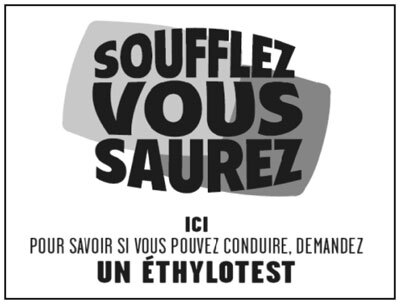
Breathalyzers should be reported by a posting information.
The poster must be placed near the exit the establishment, in the immediate vicinity of the breathalyzers.
The display must be in the format minimum of 21 × 29,7 cm (A4), and may be enlarged proportionately.
The operator shall put a instructions for use near the breathalyzer.
The package leaflet shall comply with the following technical characteristics:
- Paper support in a minimum size of 21 × 29,7 cm (A4), with no magnification limit
- Letters in character Helvetica (normal or bold) black on yellow background
The package leaflet must include the following information :
- Single use of the end piece
- Maximum display thresholds (0.10 mg/l and 0.25 mg/l in exhaled air) triggering a ticket when driving a vehicle
- Maximum duration of use between two settings and/or the maximum number of blows allowed
- Results of measurements considered unreliable, obtained with an expired breathalyzer test
- Wait time of at least 20 minutes after drinking and before blowing into the breathalyzer for the test to be reliable
- The user cannot contest the result obtained by the police during a check by presenting the result obtained with a breathalyzer previously in the establishment
- No driving if the test result is higher than 0.10 mg/l for new drivers (probationary or apprenticeship license) or higher than 0.25 mg/l for other drivers
Please note
It is possible to use templates for information media available for download from the road safety website.
Breathalyzers available free of charge for customers
Discotheque
The operator of a discotheque must have license IV to be allowed to sell alcohol.
This license allows you to sell all types of alcohol including category 4 (greater than or equal to 18°).
This authorization is valid for sale at any time, there is no need for additional permit for night sale.
A nightclub must stop serving alcohol to customers 1h30 before its closing.
Example :
If the nightclub closes at 5 am, the sale of alcohol is prohibited from 3:30 am.
The closing time of a nightclub is set at 7 hours of the morning.
Hourly restrictions of a disco
Establishments that sell alcohol for consumption on site and that close between 2am and 7am, shall make available breathalyzers free of charge of customers in a visible. These include, for example, night bars and nightclubs.
How many breathalyzers should be made available in an establishment?
When the establishment closes between 2 a.m. and 7 a.m., regardless of its size, the operator must at least 50 breathalyzers available to its customers.
They must be available at all times from the opening.
The minimum number varies according to the capacity of the establishment.
Type of device | Minimum Number |
|---|---|
Chemical Breathalyzer | 1 breathalyzer for 1/4 of the capacity |
Electronic Breathalyzer making it possible to produce a limited number of blasts |
|
Electronic breathalyzer without limitation of the number of murmurs (with annual calibration) | 1 breathalyzer for 300 people |
Reminder
The blood alcohol level is illegal and prohibits driving if it is not less than 0,5 g/l blood (and greater than or equal to 0,2g/l for young drivers in probationary permit for 2 or 3 years after the permit).
The breathalyzer gives the level of alcohol in the exhaled air (in mg of alcohol per liter of air).
Example :
0.10 mg/l of alcohol in the exhaled air corresponds to 0.2 g/l of alcohol in the blood and 0.25 mg/l of alcohol in the exhaled air corresponds to 0.5 g/l in the blood.
What checks should be carried out on breathalyzers?
The disposable tips must be in individual packagings and sealed (hermetically sealed and guaranteed to be used only once).
Warning
It is recommended to check the effective date breathalyzers, usually 2 years maximum, and to possess more than the mandatory minimum number.
How to inform customers of the presence of breathalyzers?
Breathalyzers should be reported by a posting information.
The poster must be placed near the exit the establishment, in the immediate vicinity of the breathalyzers.
The display must be in the format minimum of 21 × 29,7 cm (A4), and may be enlarged proportionately.
The operator shall put a instructions for use near the breathalyzer.
The package leaflet shall comply with the following technical characteristics:
- Paper support in a minimum size of 21 × 29,7 cm (A4), with no magnification limit
- Letters in character Helvetica (normal or bold) black on yellow background
The package leaflet must include the following information :
- Single use of the end piece
- Maximum display thresholds (0.10 mg/l and 0.25 mg/l in exhaled air) triggering a ticket when driving a vehicle
- Maximum duration of use between two settings and/or the maximum number of blows allowed
- Results of measurements considered unreliable, obtained with an expired breathalyzer test
- Wait time of at least 20 minutes after drinking and before blowing into the breathalyzer for the test to be reliable
- The user cannot contest the result obtained by the police during a check by presenting the result obtained with a breathalyzer previously in the establishment
- No driving if the test result is higher than 0.10 mg/l for new drivers (probationary or apprenticeship license) or higher than 0.25 mg/l for other drivers
Please note
It is possible to use templates for information media available for download from the road safety website.
Breathalyzers available free of charge for customers
Occasional public event (party, fair, trade show, etc.)
An exceptional festive event may result in the sale or distribution of alcoholic beverages.
These can be local festivals, balls, theatrical or cinematographic performances (excluding permanent theater-type establishments), charity sales, fairs, etc.
The responsible who organizes the event must request the authorization of the town hall at least 15 days before the event. This request applies to the sale of alcohol during the day and at night during the event.
The mayor gives his permission or not. It also gives its authorization on the opening hours closing stands that sell or distribute alcohol.
The mayor can give up to 5 authorizations per year for the same association or organization.
During these types of events, it is forbidden to sell or offer strong alcohols above 18° (whisky, vodka, rum, etc.).
Please note
Exceptionally, in the departments of Guadeloupe, Martinique and French Guiana, the mayor may authorize the sale of group 4 liquor, namely strong alcohols titrating at more than 18°, such as rum for example. It may grant up to 4 such authorizations (each valid for one day) per year.
Beverage trade
Repression of public intoxication
Sale of breathalyzers in take-away liquor stores
Ministry of the Interior
Directorate of Road Traffic Safety (DSCR)